Tuesday, August 19, 2025

The Transformation of a Wicked Brāhmaṇa through Ekādaśī


In a once-prosperous town, there lived a brāhmaṇa whose conduct was far from noble. Though born in a family of learning and piety, he had fallen deeply into the clutches of sinful life. Pride swelled in his heart. He gambled recklessly, drank without restraint, and kept company with immoral women. Disrespectful toward the Vedas, saints, and the Supreme Lord, he scoffed at the sacred, considering religious life a fool’s pursuit.

The townspeople feared him, but they also felt compassion. Many saintly brāhmaṇas prayed for his transformation, but his ears were closed, his heart hardened.


The Glorious Chance Encounter

Monday, August 4, 2025

A Hunter Is Liberated by the Grace of a Sacred Bath on Ekādaśī – by Madhu Chanda das

 A Life of Violence and Ignorance


In the remote outskirts of a dense forest, there lived a hunter. Hardened by years of killing, his life was steeped in cruelty and devoid of compassion. He hunted animals relentlessly, seeking food and gain, with no regard for dharma or virtue. Scriptures, saints, or sacred days held no meaning for him. His heart was darkened by violence, and his mind, clouded by instinct and survival.

The Sacred Day Arrives
One morning, the sun rose upon an Ekādaśī—the sacred eleventh day of the waxing moon, beloved of Lord Viṣṇu and renowned for its power to purify even the most grievous sins. Yet the hunter, unaware of the day’s divine significance, picked up his bow and set out into the forest, as he had done countless times before.

But something was different. No animals appeared. Birds flew high, deer stayed hidden, and the forest was strangely silent. Hunger gnawed at him, and thirst parched his throat as the sun climbed higher in the sky. Still empty-handed, he wandered deep into the forest until he stumbled upon the banks of a sacred river.

The Unknowing Bath
There, sages and brāhmaṇas were assembled, observing the Ekādaśī fast and bathing in the river with prayers and mantras. The air was charged with purity and devotion. The hunter, ignorant of their intentions, approached only to cool his exhausted body and quench his thirst.

He stepped into the river. As he submerged himself in the cooling water, droplets from the sages’ own sacred baths splashed upon him. Unaware, he had bathed on Ekādaśī—in a holy river and in the association of Vaiṣṇavas. Without intending to, he had performed one of the most purifying acts in all of dharma.

A Hungry Jackal in the Village Outskirts


A Hungry Jackal in the Village Outskirts

In a small village surrounded by dense forests, there lived a starving jackal. Old and weak, he could no longer hunt and was barely surviving on scraps. Driven by hunger, he would sneak into the outskirts of the village, scavenging for remains, constantly in fear of being beaten or chased away.

One evening, after a temple festival, the villagers had thrown away the leftovers of a large prasāda feast, including many preparations offered to Lord Viṣṇu. These were discarded outside the temple grounds near a garbage pit.

That night, the jackal, driven by unbearable hunger, wandered into the area and smelled the rich fragrance of the discarded food. He approached cautiously and, seeing no one around, began to devour the remnants voraciously.

The Effect of Sacred Remnants

Though unaware of the significance of the food, the jackal was consuming Mahā-prasāda—remnants directly offered to the Supreme Lord. That night, after his belly was full, he slept peacefully for the first time in many days.

While sleeping, he had a remarkable dream. In the dream, a divine figure of Lord Viṣṇu appeared, shining with brilliance, holding conch, disc, mace, and lotus. The Lord smiled at him and said:

Thursday, July 31, 2025

The Brāhmaṇa and the Crow’s Offering


The Brāhmaṇa’s Daily Worship
In a small holy village nestled by the banks of a sacred river, there lived a brāhmaṇa devoted to the worship of Lord Viṣṇu. Every day, at the same time, he would perform his pūjā with sacred mantras, purified offerings, and loving care.

His food was cooked with devotion. His altar was clean and adorned with fresh flowers. And each day, before partaking in the prasādam, he would offer it to the Lord with folded hands and full concentration.

His heart was simple and pure.

A Sudden Visitor
One morning, as the brāhmaṇa placed the plate of food before the Lord, a crow flew in through the open window, landed on the plate, and began eating.

The brāhmaṇa was horrified. “Oh no!” he cried. “The offering is ruined!”

He felt brokenhearted, for the food had not yet been formally offered. In his anguish, he cried out to the Lord, “Why did You allow this? My worship is destroyed!”

A Divine Revelation
That night, the brāhmaṇa had a dream.

Tuesday, July 29, 2025

The Spider Who Served the Lord

 A Small Creature with a Great Heart


In ancient times, there was a grand temple of Lord Śrī Rāma, situated on the banks of the sacred river Gaṅgā. Devotees from near and far came to offer flowers, incense, lamps, and foodstuffs to the Lord with deep devotion. The temple was filled with wealth and opulence—its floors were made of polished marble, its dome covered with golden carvings, and its priests dressed in silken robes.

Among the thousands of pilgrims and priests, no one noticed a tiny spider who lived quietly in one corner of the temple hall. While others offered jewels and camphor, this little spider, day after day, would do a peculiar service—it would spin a small web to keep the dust away from the altar.

This was not just instinct. The spider had devotion in its heart. It thought, “Let me do what I can. If I can keep even one speck of dust from touching the Lord, my life will be successful.”

A Powerful Sage Objects

One day, the great sage Śrī Hanumān, in the form of a monkey as he often remained, entered the temple. He bowed deeply before his beloved Lord Rāma, and then began cleaning the temple with his tail, using it like a broom to remove every trace of impurity.

As he moved near the altar, he saw a web spun by the spider. Displeased, Hanumān roared, “What is this filth near the altar of my Lord?” And with one swipe, he broke the web and crushed the spider beneath his tail.

At that very moment, a divine voice echoed from the deity of Lord Rāma:

Monday, July 28, 2025

Brahma visit to Lord Krishna in Dvaraka

 The Arrival of Brahma


Once, when Krsna was ruling Dvaraka, Lord Brahma came to see Him, and the doorman immediately informed Lord Krsna of Brahma’s arrival.

Krsna’s Question

When Krsna was so informed, He immediately asked the doorman, `Which Brahma? What is his name?’

Brahma’s Surprise

The doorman therefore returned and questioned Lord Brahma.

When the doorman asked, Which Brahma?' Lord Brahma was surprised. He told the doorman, Please go inform Lord Krsna that I am the four-headed Brahma who is the father of the four Kumaras.’

Brahma’s Entry

The doorman then informed Lord Krsna of Lord Brahma’s description, and Lord Krsna gave him permission to enter. The doorman escorted Lord Brahma in, and as soon as Brahma saw Lord Krsna, he offered obeisances at His lotus feet.

Brahma’s Question

After being worshiped by Lord Brahma, Lord Krsna also honored him with suitable words. Then Lord Krsna asked him, `Why have you come here?’

Being questioned, Lord Brahma immediately replied, `I shall later tell You why I have come. First of all there is a doubt in my mind which I wish You would kindly dissipate.

The Purpose of the Inquiry

`Why did you inquire which Brahma had come to see You? What is the purpose of such an inquiry? Is there any other Brahma besides me within this universe?’

The Arrival of Multiple Brahmas

Upon hearing this, Sri Krsna smiled and immediately meditated.

Unlimited number of Brahmas arrived instantly.

These Brahmas had different numbers of heads. Some had ten heads, some twenty, some a hundred, some a thousand, some ten thousand, some a hundred thousand, some ten million and others a hundred million. No one can count the number of faces they had.

Tuesday, November 24, 2020

Drutakarma Das Working on New Book About Extreme Human Antiquity

 By:  for ISKCON News on Nov. 21, 2020


Drutakarma Das, October 2016

Drutakarma Das (Michael Cremo), co-author of Forbidden Archeology, is at work on a new book, tentatively titled “Extreme Human Antiquity.” 

The book, Drutakarma says, “Is composed of new cases of archeological evidence that are consistent with Vedic and Puranic accounts of very ancient human presence on this planet.”

Expected some time in Spring or early Summer 2021, each chapter of “Extreme Human Antiquity” represents a different geological epoch, starting with the most recent and going back to more and more ancient times.

“Most scientists now think that humans like us first appeared about 300,000 years ago,” says Drutakarma Das, a research associate of the Bhaktivedanta Institute. “So I’m interested in discoveries that show human beings like us existed more than 300,000 years ago.”

In the book’s introductory chapter, Drutakarma explains what he means by the terms “anatomically modern Homo sapiens” and “extreme human antiquity.” In chapter two, he looks at archeological discoveries from the Pleistocene Epoch, typically defined as ending about 11,700 years ago and going back to about 2.6 million years ago. In chapter three, he looks at the Pliocene Epoch, spanning from around 2.6 million years ago to some 5.3 million years ago. The next chapter discusses discoveries from the Miocene Epoch, spanning from about 5.3 million years ago to 23 million years ago; and so on.

British Queen Elizabeth Grateful for Back To Godhead Article


By:  for ISKCON News on Oct. 1, 2020


Queen Elizabeth II. 

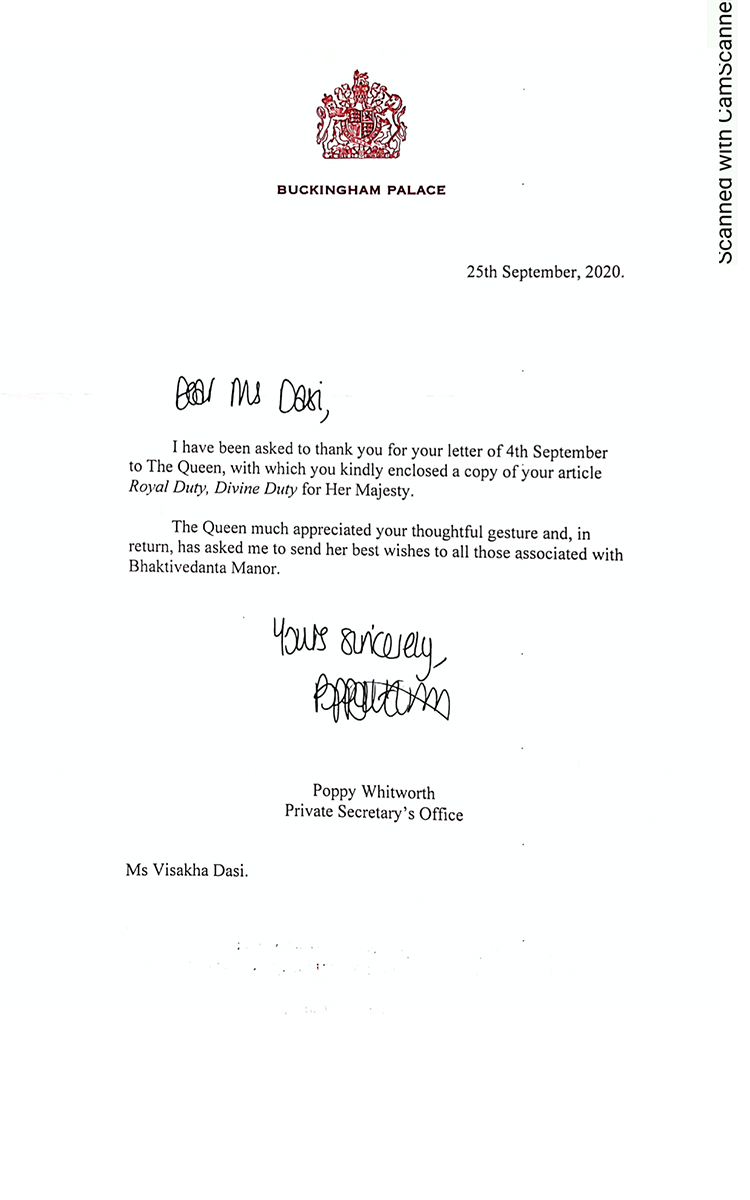
A letter was recently sent to the president of Bhaktivedanta Manor, Visakha dasi, from Her Majesty the Queen of England, via her Private Secretary's Office. The letter thanked Vishaka for her recent Back To Godhead article about the Queen, entitled, "Royal Duty - Divine Duty" that was published in the July/August edition of BTG.  

"It was a very positive article praising the Queen's devotion to her duty, and how everyone can get closer to God through our own attention to duty and service," reports Radha Mohan Das, ISKCON Communication spokesperson at the Manor.  

The Queen has had multiple interactions with ISKCON in recent years, including inviting ISKCON leaders to the Buckingham Palace for special events, and a personal royal visit to the Krishna Avanti Primary School in Harrow, UK, with her husband, Prince Philip, Duke of Edinburgh, during her Majesty’s Jubilee celebrations in 2012. 

Tuesday, August 13, 2019

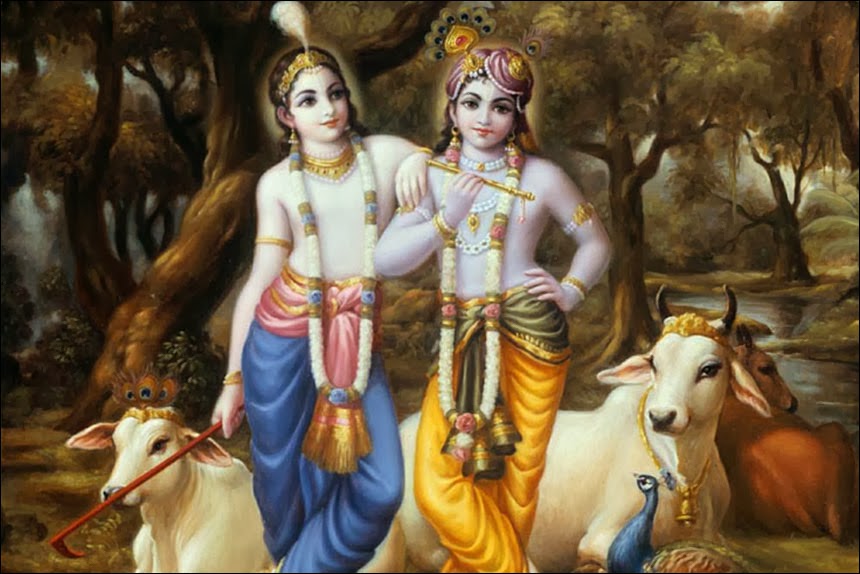
LORD SRI KRISHNA AND BALARAMA ARE NOT AVATARAS OF BLACK AND WHITE HAIRS OF LORD VISHNU


Lord Sri Krishna and Balarama are not avataras of black and white hairs of Lord Vishnu


krishna-and-balarama860

From Sri Tattva Sandarbha of Srila Jiva Goswami

Objection:

Is it not so that (Krishna and Balarama), who appeared in the Yadu dynasty, are incarnations of a black and white hair of Lord Vishnu. This is clearly described in Shrimad-Bhagavatam (2.7.26):
“When the world is overburdened by the fighting strength of kings who have no faith in God, just to diminish the distress of the world, a black and white hair of the Lord incarnate on the earth. To expand His transcendental glories the Lord acts extraordinarily. No one can properly estimate how great He is.”

Many translators have interpreted the above verse of Srimad Bhagavatam, a verse from Vishnu Purana and Mahabharata to mean Lord Krishna and Balarama are incarnations of black and white hairs of Lord Visnu respectively.

Refutation:

(To this objection I (Srila Jiva Goswami) reply:) O, don’t interpret this verse in that way. Please listen and I will now give the proper interpretation of the verse. The word “kalaya” means with great artistry”, “sita” means “bound”, and “krishna” means “very dark”. The compound word “sita-Krishna-kesha” means “He whose beautiful black hair is neatly tied”. The word “kalaya” indicates that Lord Krishna was the most expert of all artists.
Note: The entire verse may then be interpreted in the following way:
“When the world is overburdened by the fighting strength of kings who have no faith in God, the Lord, just to diminish the distress of the world, descends in His original form, with beautiful black hair neatly tied on His head. The Lord is the most expert of all artists, and just to expand His transcendental glories, He performs many graceful and extraordinary pastimes. No one can properly estimate how great He is.”
The word “kalaya” may also be interpreted to mean “with His plenary portion”. If this meaning is accepted the verse may be interpreted in the following way:
“Lord Krishna, the Supreme performer of pastimes, has beautiful black hair. He descended to the material world, accompanied by His plenary portion (kalaya).”
[Note: That Krishna appeared with his planary portions will be explained later in detail with scriptural references as it is big topic ]
In the Vishnu-dharmottara Purana, Markandya Muni describes to Maharaja Vajra (the king’s) father, Aniruddha, who appears on the ocean of devastation:
Vajra’s question: “Who is the person in the form of a child that again and again you see at each millenium’s end? I do not know, and I am very eager to know.”

Thursday, May 9, 2019

SRI CHANAKYA NITI-SASTRA TRANSLATED BY HIS GRACE PATITA PAVANA DAS ACBSP


CHAPTER ONE

1. Humbly bowing down before the almighty Lord Sri Vishnu, the Lord of the three worlds, I recite maxims of the science of political ethics (niti) selected from the various satras.

2. That man who by the study of these maxims from the satras acquires a knowledge of the most celebrated principles of duty, and understands what ought and what ought not to be followed, and what is good and what is bad, is most excellent.

3. Therefore with an eye to the public good, I shall speak that which, when understood, will lead to an understanding of things in their proper perspective.

4. Even a pandit comes to grief by giving instruction to a foolish disciple, by maintaining a wicked wife, and by excessive familiarity with the miserable.

5. A wicked wife, a false friend, a saucy servant and living in a house with a serpent in it are nothing but death.

6. One should save his money against hard times, save his wife at the sacrifice of his riches, but invariably one should save his soul even at the sacrifice of his wife and riches.

7. Save your wealth against future calamity.

Patita Pavana Prabhu praying to Srila Prabhupada 


Do not say, "What what fear has a rich man of calamity?" When riches begin to forsake one even the accumulated stock dwindles away.

8. Do not inhabit a country where you are not respected, cannot earn your livelihood, have no friends, or cannot acquire knowledge.

9. Do not stay for a single day where there are not these five persons: a wealthy man, a brahmana well versed in Vedic lore, a king, a river and a physician.

10. Wise men should never go into a country where there are no means of earning one's livelihood, where the people have no dread of anybody, have no sense of shame, no intelligence, or a charitable disposition.

11. Test a servant while in the discharge of his duty, a relative in difficulty, a friend in adversity, and a wife in misfortune.

12. He is a true friend who does not forsake us in time of need, misfortune, famine, or war, in a king's court, or at the crematorium (smasana).

13. He who gives up what is imperishable for that which perishable, loses that which is imperishable; and doubtlessly loses that which is perishable also.

14. A wise man should marry a virgin of a respectable family even if she is deformed. He should not marry one of a low-class family, through beauty. Marriage in a family of equal status is preferable.

15. Do not put your trust in rivers, men who carry weapons, beasts with claws or horns, women, and members of a royal family.

16. Even from poison extract nectar, wash and take back gold if it has fallen in filth, receive the highest knowledge (Krsna consciousness) from a low born person; so also a girl possessing virtuous qualities (stri-ratna) even if she be born in a disreputable family.

17. Women have hunger two-fold, shyness four-fold, daring six-fold, and lust eight-fold as compared to men.

Sunday, December 10, 2017

SANT TUKARAMA’S DEHU DHAMA AND PUNE YATRA VISITING HOLY PLACES

Sant Tukarama’s Dehu Dhama
and Pune Yatra
cid:image005.jpg@01D36553.6E37D4C0
Sant Tukarama

Sant Tukarama (AD 1609-1650) was a saint-poet of towering stature. Tukarama was among the most prominent saints to have come out of the holy land of Maharashtra. He hailed from the village of Dehu, near Pune, and was born in the Warkari community who are devotees of Lord Vitthala (or Panduranga). Srila Prabhupada occasionally referred to this great saint, “The great saint of Maharashtra known as Saint Tukarama was also initiated by the Lord Caitanya. Saint Tukarama, after initiation by the Lord, over-flooded the whole of the Maharashtra Province with the sankirtana movement and the transcendental flow is still rolling on in the southwestern part of the great Indian peninsula.” (Srimad-Bhagavatam - Introduction)

Thursday, November 16, 2017

MADURAI YATRA MATHURA OF SOUTHERN INDIA (DAKSINA-MATHURA)

Madurai Yatra
Mathura of Southern India (Daksina-mathura)

cid:image002.jpg@01D353F4.466FBD10

Southern Mathura (Daksina-mathura), presently known as Madurai, is situated on the banks of the Vaigai River and is one of South India’s great temple towns. Madurai is synonymous with the celebrated Meenakshi Temple. On the day the city was to be named, as Lord Siva blessed the land and its people, divine nectar (Madhu) was showered on the city from Lord Siva’s matted locks. This city was henceforth known as Madhurapuri. During His South India tour in 1510 AD, Lord Caitanya Mahaprabhu visited Madurai twice, once while going to Rameswaram after meeting the brahmana Ramdasa Vipra, who was a staunch devotee of Lord Ramacandra. The next time was on the way back from Rameswaram with a copy of the Kurma Purana scripture, which had a verse stating that Ravana had kidnapped an illusory Sita, and that the real Sita was safely hidden by Agnideva. Lord Caitanya personally gave this copy to Ramdasa Vipra to dispel his doubts about mother Sita’s kidnapping.

A great Vaishnava, Srila Narayana Bhatta Gosvami, who was a very close associate of Srila Sanatana Gosvami appeared in Madurai. the identity of Srila Narayana Bhatta Gosvami is revealed as Narada Muni. Lord Balarama visited Madurai during His holy pilgrimage [Srimad-Bhagavatam Canto 10 chapter 79 verses 11-15]. Srila Bhaktisiddhanta Sarasvati Thakura visited Madurai in the year 1904 and collected all the information about the rites and rules of Vedic tridanda Vaishnava sannyasa from a Ramanujan tridandi Swami at Perambalur. A.C. Bhaktivedanta Swami Prabhupada also visited Madurai once during his household days for business. “It was at Madurai that Abhay showed some of his writings to Muthuswamy Chetty, another medical salesman. Mr. Chetty was impressed and felt he could persuade his wealthy friend Dr. Alagappa Chettiar, the famous Birla of the South, to finance the printing of Geetopanishad manuscript.” - Prabhupada Lilamrita. However this project could not progress ahead as Abhay found his original manuscript missing from his house which he could never ever find. Probably stolen by servants or given out for some money by family members.

This place of pilgrimage is specifically meant for the devotees of Lord Siva; therefore it is called Saiva-ksetra, that is, the place where Lord Siva is worshiped. In this area there are mountains and forests. There are also two Siva temples, one known as Ramesvara and the other known as Sundaresvara. There is also a temple to Devi called the Minaksi-devi temple, which displays very great architectural craftsmanship. It was built under the supervision of the kings of the Pandya Dynasty, and when the Muslims attacked this temple, as well as the temple of Sundaresvara, great damage was done. In the Christian year 1372, a king named Kampana Udayar reigned on the throne of Madurai. Long ago, Emperor Kulasekhara ruled this area, and during his reign he established a colony of brahmanas. A well-known king named Anantaguna Pandya is an eleventh-generation descendant of Emperor Kulasekhara. [Sri Caitanya Caritamrta Madhya lila chapter 9 verse 179]

Madurai has a rich cultural heritage passed on from the great Tamil era more than 2500 years old. Madurai was an important cultural and commercial centre even as early as 550 AD. It was the capital city for the great Pandya kings. The Pandyan King Kulasekhara built a great temple and created a lotus shaped city around the temple. Madurai is famous for Jasmine Flowers.

Wednesday, October 18, 2017

SRI AMRITSAR YATRA PUNJAB INDIA

Sri Amritsar Yatra
cid:image009.jpg@01D32CAF.E6A4B810

The Holy city of Amritsar derives its name from Amrit Sarovar, literally a Pool of Nectar, the holy tank that surrounds the fabulous Golden Temple. Historically also known as Ramdaspur and colloquially as Ambarsar, Amritsar is in Punjab state in north-western India, 25 km east of the border with Pakistan. Amritsar is home to the magnificent Harmandir Sahib, commonly known as the Golden Temple, the spiritual and cultural centre for the Sikh religion. The Golden Temple “gurudwara”, as Sikh temples are called, is a serene place and the holiest of shrines, radiating a calm that makes people bow their heads in reverence. Amritsar was founded in 1577 by the fourth Sikh guru, Guru Ram Das. The fifth Sikh Guru, Guru Arjan, designed Harmandir Sahib to be built in the centre of this holy tank, and upon its construction, installed the Adi Granth, the holy scripture of Sikhism, inside Harmandir Sahib and is regarded as the abode of God's spiritual attribute. This sacred shrine is equally revered by all faiths. Harmandir Sahib Temple is open 24 hours, and inside the Temple there is constant Kirtan.

Thursday, October 5, 2017

UJJAIN YATRA SRI AVANTIKA DHAMA INDIA

Ujjain Yatra
Sri Avantika Dhama

Ujjain is an ancient holy city on the bank of the Kshipra River, today part of the state of Madhya Pradesh in central India. Ujjain is the place where Lord Krishna, along with Balarama and Sudama, received education from Maharishi Sandipani. Ujjain is one of the four sites in India that host the Kumbh Mela (also called the Simhastha Mela), once in 12 years. On the occasion of Simhastha Kumbh Mela the divinity and spiritual aroma of Ujjain meets its highest peak when millions of pilgrims take dips and worship sacred River Kshipra. The Garuda Purana enumerates seven sacred cities (Sapta Moksha Puri) as giver of Moksha (Ayodhya, Mathura, Maya, Kasi, Kanchi, Avantika, Dwarka); Ujjain or Avantika is one among these seven sacred cities. Lord Ramacandra along with Sita-devi and Laxmana also came to Ujjain. Lord Ramacandra performed the ‘Pind-dan’ ceremony for His father Dasaratha at the Ram Ghat on the bank of Kshipra river, which is the famous holy site of Kumbh Mela. This simple and peaceful city is famous for its principal deity Sri Mahakaleshwar who is one of the 12 self-manifested Jyotilingams of Lord Siva. Lord Krishna's principal queen Mitravinda was from Ujjain. Ujjain is one of the 52 Shakti peethas in India. Lord Siva killed demon Tripurasur here in Ujjain. International Society for Krishna Consciousness (ISKCON) has a gorgeous Temple in Ujjain with exquisitely beautiful deities of Sri Sri Radha Madan Mohan, a flourishing Tulsi garden and attractive lush flower gardens, Goshala, gift shops, restaurant and a Guest House.

There is an interesting pastime behind the sanctity of the city. Its origin is ascribed to the legend of Sagar Manthan (churning of the primordial ocean to discover the pot of nectar). After the nectar was discovered, there was a quarrel between the demigods and the demons to have the nectar first and thus attain immortality. Demigods and demons fought in the sky for the pot of amrita. As Srimad-Bhagavatam (Bhagavata Purana) Canto 8, chapter 9 states, the Supreme Personality of Godhead Lord Sri Krishna incarnated as Mohini-Murti and flew away with the Kumbh of elixir spilling drops of amrita at four places: Allahabad, Haridwar, Ujjain and Nashik. So, a drop of amrit nectar spilled and fell on Ujjain, thus making the city sacred.

Since Ujjain is one of the oldest cities in India, it has been known by many names: Avantika, Padmavati, Kushasthali, Bhagavati, Haranyavati, Kandakatringa, Kumudvati, Pratikalpa, Ujjayani, Udeni Vishala. In the Mahabharata, Ujjayini was the capital of the Avanti Kingdom. To the western astronomers Ujjain was known as "Arin", which was used as the centre of ancient and medieval world maps. One of the most famous kings of Ujjain of his time was king Vikramaditya. He was famous for his kshatriya spirit and also great intelligence. His encounter with the Vetal demon and his special simhasan are well known. The throne of Maharaja Vikramaditya, known as the "seat of judgment (salabanjika throne)" is said to be still there in Ujjain.

Ujjain is 55km (1 hour drive) from Indore. Indore is well connected by Air, Rail, Bus transport.

Important places to visit Ujjain:
1. Sandipani Muni Ashram
2. Narayana Gaon
3. Sri Rama Janardhana Temple
4. Ram Ghat (or Kshipra River Ghat)
5. Sri Nrsimha Ghat Temple
6. Sri Mahakaleshwar Temple
7. ISKCON Ujjain (Hare Krishna) - Sri Sri Radha Madan Mohan Temple
8. Harsiddhi Temple
9. Sri Siddhwat Ghat
10. Sri Bharthari Caves
11. Sri Gadkalika Temple
12. Sri Mangalnath Temple
13. Sri Gopal Mandir
14. Sri Ram Mandir
15. King Vikramaditya Throne
16. ISKCON Indore (Hare Krishna) - Sri Sri Radha Govinda Temple

The Transformation of a Wicked Brāhmaṇa through Ekādaśī

In a once-prosperous town, there lived a brāhmaṇa whose conduct was far from noble. Though born in a family of learning and piety, he had fa...